
How to choose a bedside table: height, size and 4 models
A practical guide to matching bedside table height to the mattress, measuring the available space and comparing four distinct designs.

A bedside table is small, yet the wrong height, excessive depth or a drawer that cannot open comfortably will be noticeable every day. Before choosing one, measure more than the empty wall: check the height of the mattress surface, the walkway and the items you keep within reach. This guide compares four different options from the Bonideco bedside table and nightstand range.
Quick guide: plan the top close to mattress height; in a tight space, use the actual width and depth; a wall-mounted cabinet lets you choose the installation height, while a shelf hung from the bed frame uses no floor space. A drawer hides small items, while an open shelf keeps everyday objects easy to reach.
Bedside tables compared: 4 different designs
We selected four models for different situations: a shelf that uses no floor space, a low compact nightstand, a taller cabinet with a charging station and a pair of wall-mounted cabinets. Dimensions and construction were checked against the Bonideco catalogue and manufacturer information on 15 September 2026. This is a feature comparison; we did not physically test the products. Current prices and availability appear in the product cards.
| Model | Dimensions | Design | Best suited to |
|---|---|---|---|
| VASAGLE LET301N03 | 27 × 37.8 × 7.9 cm | Bamboo shelf that hangs from the bed frame, with a cup holder and hook | Rooms without space for a freestanding table |
| VASAGLE LET619T56 | 28 × 39 × 41 cm | Freestanding model with one drawer and an open shelf | Lower beds and a modest amount of bedside storage |
| VASAGLE LET631B56 | 35 × 40 × 59 cm | Freestanding three-drawer cabinet with charging station | Closed storage and power connections beside the bed |
| VASAGLE LET854W01 | 35 × 40 × 18 cm each | Pair of wall-mounted cabinets with a drawer and lighting | Double beds where clear floors and adjustable installation height matter |
Remember: a low cabinet body does not necessarily create a low bedside surface. The final height of a wall-mounted unit depends on where it is installed, while a bed-frame shelf follows the construction of the bed. Check the selected product variant and its installation instructions before ordering.
What height, width and depth should a bedside table be?
Measure height to the mattress surface
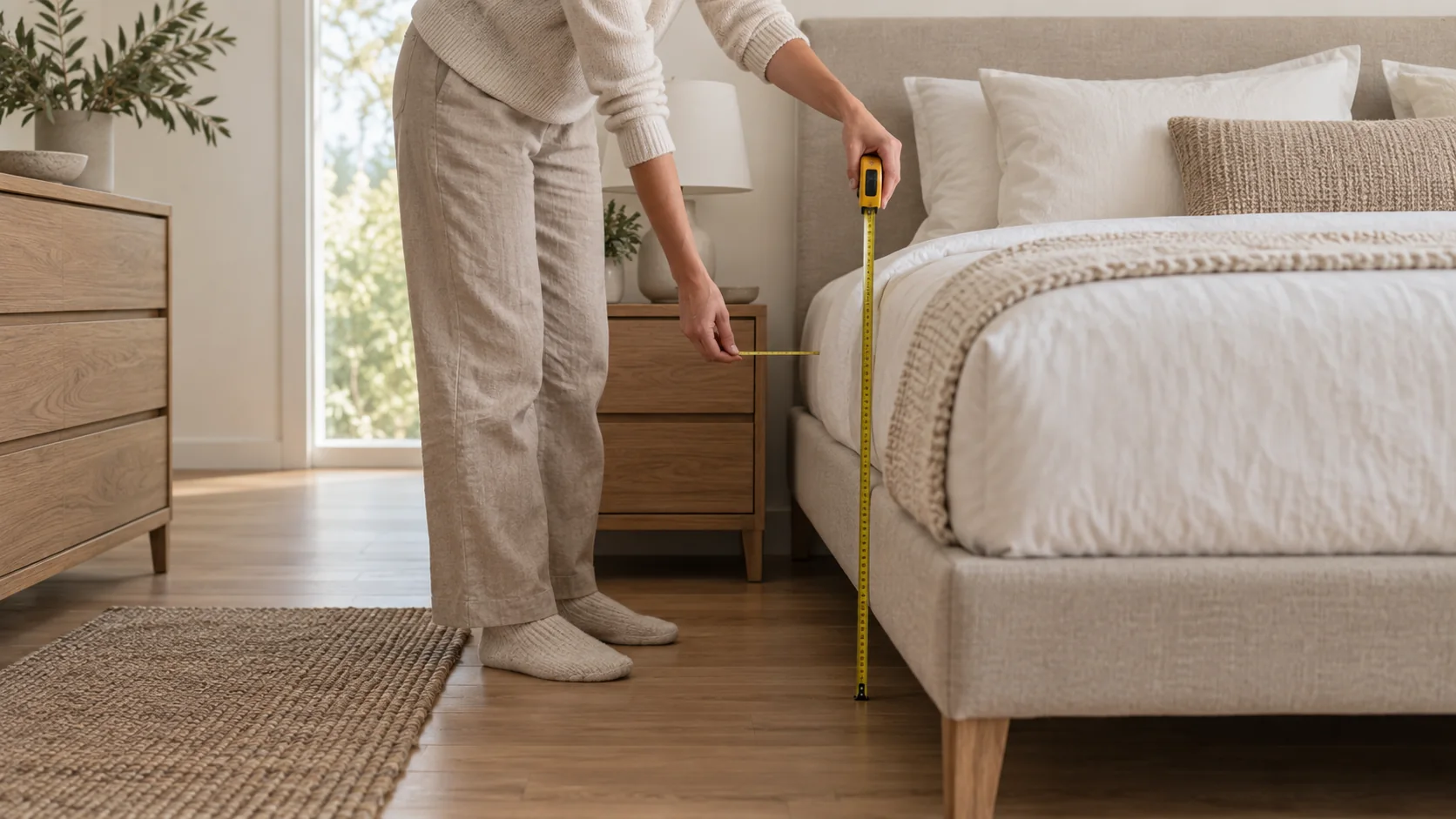
Measure from the floor to the top of the mattress with the bed fully made up for sleep. A frame, deep mattress or topper can make the finished bed height quite different from the frame dimension shown in a bed listing. Compare this number with the height of the nightstand.
A top close to the mattress surface allows many people to reach a phone, glasses or water without an awkward bend. Treat this as a starting point rather than a fixed rule. Lie on your usual side, reach out and mark the comfortable zone. A 41 cm table may suit a low bed, while a 59 cm cabinet may work with a taller one; a wall-mounted unit offers more freedom.
Use the narrowest point for width
Measure from the edge of the bed to the wall, radiator, wardrobe or door swing. Include the skirting board and any projecting part of the bed frame. If the available width differs on each side, two matching freestanding cabinets are not essential: a narrower shelf can work on the tighter side.
Check depth together with the walkway
The front of the cabinet should not intrude awkwardly into the route around the bed. Mark its footprint on the floor with removable tape, then walk past it several times. For a drawer, allow space to pull it out fully and to stand in front. The 27–28 cm deep options in this comparison use less walkway than the 35 cm models, but they also offer different storage.
Which bedside table suits your needs?
When almost no floor space is available: VASAGLE LET301N03
This 37.8 cm wide bamboo shelf hangs from a compatible bed frame, so it needs no separate floor area. A cup holder and hook free up its main surface. It is useful in a small bedroom, beside a bunk bed or where a conventional nightstand will not fit.
It is a bed-frame shelf, not a cabinet fixed to the wall. Compatibility depends on the edge of the bed frame and the attachment method. Measure the frame, check the support point and the manufacturer's load instructions, and make sure the shelf will not obstruct getting into bed.
For a compact, lower setup: VASAGLE LET619T56
The 39 cm wide, 28 cm deep and 41 cm high nightstand has one drawer and one open compartment. The drawer can conceal small belongings, while the shelf keeps a book or another frequently used item close at hand. Its shallow footprint helps where the walkway matters.
Compare the 41 cm height with the top of your mattress. Beside a tall bed, the surface may sit below your comfortable reach. Also check whether the 39 cm wide top can hold your lamp while leaving a secure place for other items.
For closed storage and charging: VASAGLE LET631B56
The 59 cm high model combines three drawers with a charging station in the top. It suits anyone who wants to hide more small items and keep power connections together beside the bed. Its 40 cm width is still compact, but the 35 cm depth and opening drawers need more clear space.
Plan the cable route to the wall socket before positioning it. The lead should not cross the walkway or become pinched behind the furniture. Check the ports, cable length and operating instructions for the exact variant, as similar-looking versions do not necessarily have the same equipment.
For both sides of a double bed: VASAGLE LET854W01
The set contains two 40 cm wide wall-mounted cabinets, each with a drawer and lighting. The 18 cm high cabinet body can be positioned to suit the mattress, while the clear floor underneath is easier to clean. The white closed fronts keep the arrangement visually calm.
A wall-mounted cabinet is suitable only when the wall and fixings can safely support the intended load. Establish the wall construction and the position of cables and pipes before drilling. Follow the product instructions, and consult a qualified installer if the wall or suitable fixings are uncertain.
Wall-mounted or freestanding bedside table?
A freestanding table is easier to move when the bed or room layout changes. It does not require drilling, but it occupies floor space. Check stability on an uneven floor and fit any manufacturer-provided anti-tip restraint as instructed.
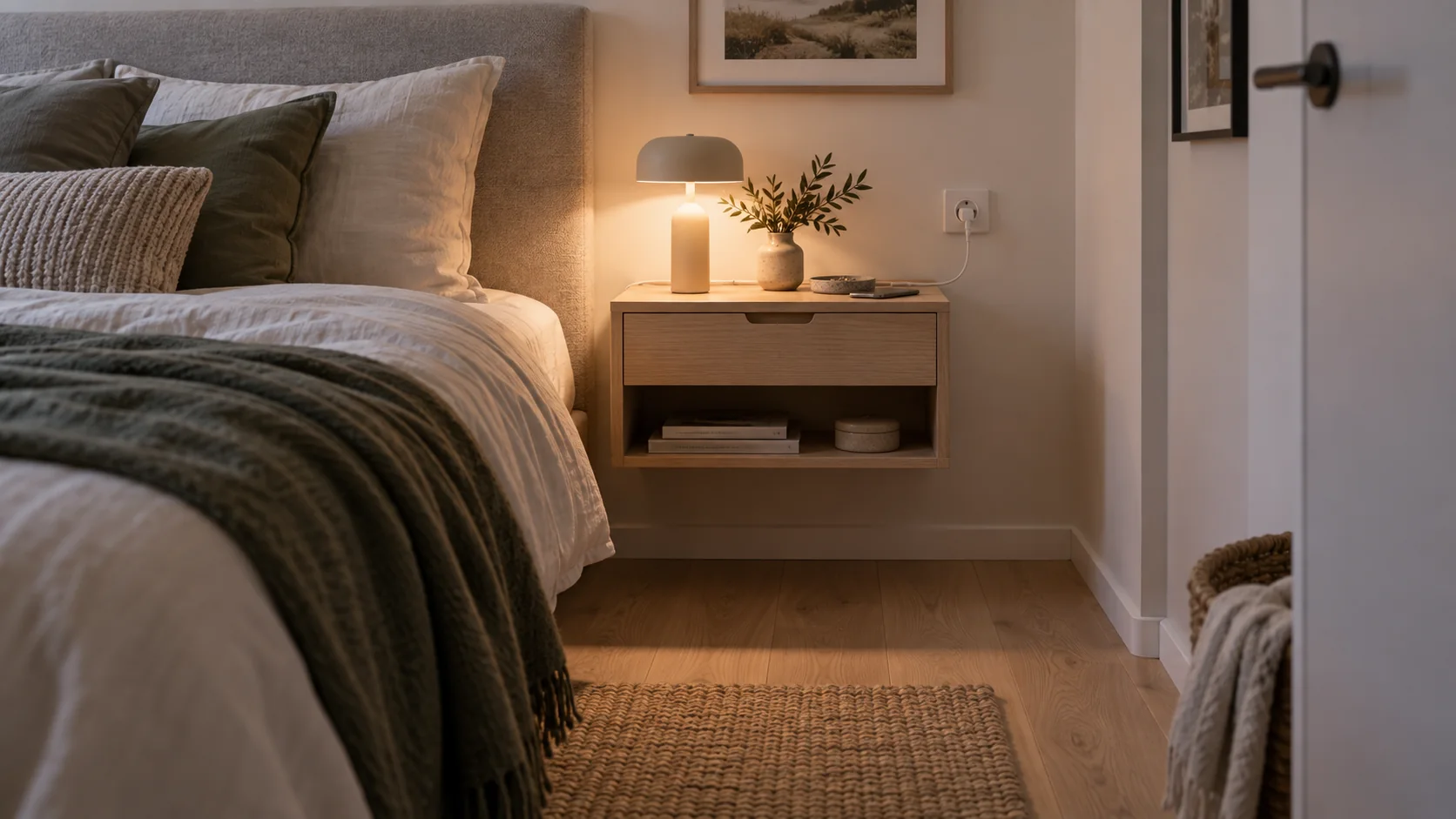
A wall-mounted cabinet can be positioned for a particular bed and leaves the floor clear. It requires a suitable wall and the correct fixings. Consider the weight of the cabinet together with everything placed in the drawer and on its top.
A shelf hung from the bed frame is a third option. It saves space and avoids wall mounting, but it will not fit every bed. The surface is generally smaller, so it works best for a few essentials.
For a coordinated bedroom, repeat one element from the bed: a wood tone, colour or metal detail. Every item does not have to match exactly. If you are also planning a getting-ready area, compare the width of the dressing table so drawers and walkways do not compete for the same space; our dressing-table comparison includes more measurement examples.
7 checks before buying a nightstand online
- Measure the top of the mattress. Use the finished bed height, including the mattress and topper.
- Mark the footprint. Put the width and depth on the floor with removable tape; mark a wall-mounted cabinet lightly on the wall.
- Test the walkway. Account for wardrobe and room doors, radiators, curtains and a robot vacuum.
- Allow for opening. A drawer or door needs space in front and comfortable access.
- List what you will store. A lamp needs top area, books need shelf clearance, small items need a drawer and a phone needs a sensible cable route.
- Check mounting and contents. Match wall units to the wall and hanging shelves to the bed frame. Do not assume props shown in a photograph are included.
- Read the exact listing. Confirm dimension order, materials, load limits, assembly, electrical connections and delivery information.
This process narrows the choice by real space and habits, leaving colour as a decision between models that already fit. Browse all Bonideco bedside tables or open the compared product cards below.
Frequently asked questions
How high should a bedside table be?
A top close to the mattress surface is a useful starting point, but your bed and comfortable reach determine the best position. Measure from the floor to the mattress and test where you can reach objects easily while lying down.
How much space should I allow for a nightstand?
Begin with the cabinet's width and depth, then add space to open a drawer or door and to walk past comfortably. Measure the narrowest point, including the skirting board, bed frame and opening zones of nearby furniture.
Is a floating bedside table better for a small bedroom?
It clears the floor and offers a flexible installation height, but it needs a suitable wall. If drilling is not possible, consider a shallow freestanding model or a shelf compatible with the bed frame.
Do I need two matching nightstands for a double bed?
No. Matching units add symmetry and give both sleepers storage, but rooms with unequal space can use different designs with coordinated functions or finishes. Comfortable height and the needs on each side matter more.
What is the difference between a bedside table and a nightstand?
The terms overlap. “Bedside table” can describe an open design, while “nightstand” often suggests drawers or a door, but retailers use both in different ways. Exact measurements and storage layout are more useful than the label.
Is a bedside table with a charging station worthwhile?
It can be convenient if you charge devices beside the bed and have a suitable wall socket nearby. Check the port types, lead length and route so the cable does not cross the walkway. Use the electrical features according to the manufacturer's instructions.